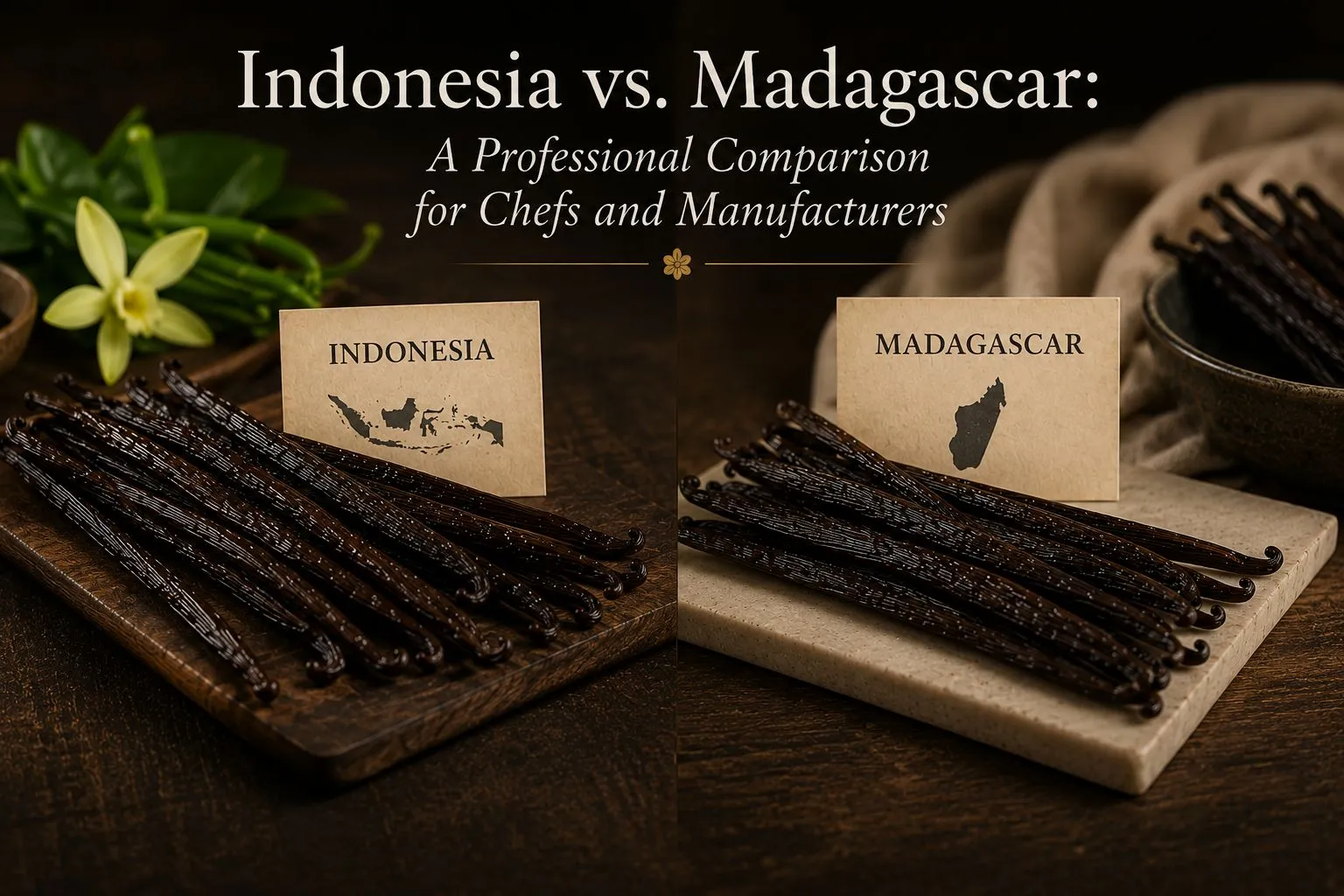
Madagascar vanilla planifolia accounts for roughly 80% of global vanilla supply. It is the global default. But Indonesian vanilla, grown on the volcanic highland farms of Java and Sulawesi, is a different product. Not inferior. Different. And for many professional applications, better suited.
The Flavor Comparison
Madagascar vanilla is characterized by a sweet, creamy, floral profile. Indonesian vanilla is smokier, earthier, and more complex. It carries secondary notes of woodsmoke, dried fruit, and dark spice that give it depth Madagascar vanilla often lacks. In a vanilla custard or a classic creme brulee, Indonesian vanilla produces a more layered, less one-dimensionally sweet result.
Indonesian vanilla does not replace Madagascar vanilla. It expands the vocabulary of what vanilla can do - particularly in savory-adjacent and complex dessert applications.
Technical Performance Differences
Indonesian beans typically have a higher natural vanillin content - 1.5-2.5% versus 1.2-2.0% for Madagascar in most lots. This means stronger flavor impact per gram in extraction applications and better yield efficiency in food manufacturing contexts where vanillin targets are specified by recipe.
When To Choose Indonesian Vanilla
For pastry and confectionery applications where vanilla is a signature note, particularly in chocolate, caramel, and dark sugar contexts, Indonesian vanilla smoky complexity is a genuine advantage. For gelato and ice cream, the layered profile creates a more interesting result. For extract production at scale, the higher vanillin content provides better yield.